
PATIENT INFORMATION
Enlarged Adenoids in Children
The adenoid is lymphoid tissue at the back of the nose, in the nasopharynx. It grows naturally during childhood and tends to shrink after school age. In some children its size narrows the nasal airway and the opening of the eustachian tube, affecting breathing through the nose, sleep and ventilation of the middle ear. This page explains what enlarged adenoids mean, which symptoms occur, what is done in the ENT assessment and the general principles of management.
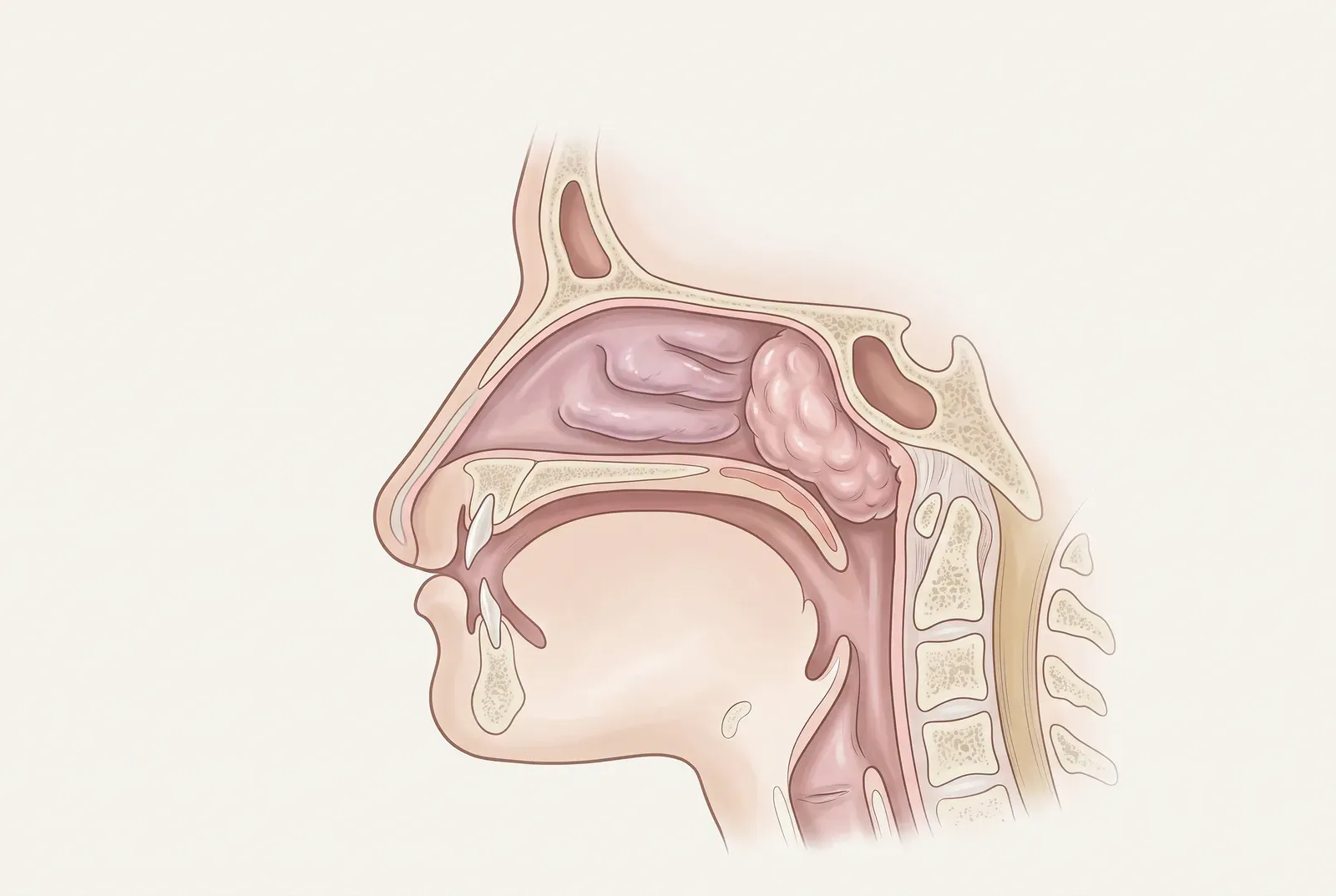
What is the adenoid?
The adenoid, also called the pharyngeal tonsil, is lymphoid tissue in the nasopharynx, the space at the top of the throat behind the nasal cavity. Together with the tonsils it belongs to the defensive tissue of the upper airway, and every child has it.
The tissue grows in the first years of life under the influence of repeated upper respiratory infections, usually reaching its most prominent size between about two and six years of age, and shrinks from school age onwards. The problem is not the presence of the tissue but a size that narrows the nasopharyngeal airway appreciably.
The adenoid lies next to the opening of the eustachian tube in the nasopharynx. Its enlargement can therefore affect not only breathing through the nose but also ventilation of the middle ear; repeated ear problems and middle-ear fluid are common consequences of that relationship.
Common symptoms
The symptoms of enlarged adenoids follow from narrowing of the airway and from the effect on neighbouring structures:
- Difficulty breathing through the nose and constant mouth breathing
- Snoring, restless sleep and sleeping with the mouth open
- Hyponasal speech (a blocked, nasal-sounding voice)
- Persistent nasal discharge and postnasal drip
- Repeated middle-ear problems, fluid in the ear and the reduced hearing that follows
- Dry mouth and bad breath from prolonged mouth breathing
These symptoms can also arise from allergic rhinitis, structural narrowing inside the nose and frequent infections, and more than one cause may be present at once. The purpose of assessment is to establish how far the complaint is explained by the size of the adenoid.
What is done in the ENT assessment?
The assessment begins with a detailed history: how breathing through the nose behaves by day and by night, snoring and breathing during sleep, how long mouth breathing has been present, repeated ear and upper respiratory infections, hearing and speech development, allergic complaints, and the effects on school and feeding.
During the examination the nose and the mouth are inspected; the eardrums are assessed with an otoscope and, where needed, tympanometry measures ventilation of the middle ear. In children who have breathed through the mouth for a long time, changes in facial and jaw development are also looked for.
The nasopharynx is seen directly by endoscopic examination through the nose with a thin, flexible instrument (nasopharyngoscopy); this shows the size of the adenoid and how much it narrows the airway, and it is the method relied on today. In some situations imaging such as a lateral radiograph may also be used; which method is chosen is decided by the physician according to the child’s age and the examination findings.
Where findings suggest that breathing during sleep is affected, assessment of sleep-related breathing is a separate matter and is handled, where needed, together with the relevant specialties.
Management principles
The approach is determined by the severity and duration of symptoms, by any accompanying ear and sleep problems, and by the child’s age.
Where complaints are mild and intermittent, observation may be appropriate, bearing in mind that the picture can improve on its own as infections become less frequent and the adenoid tends to shrink with age. Where allergic rhinitis or another inflammatory process of the nasal lining is present, treating it can noticeably ease breathing through the nose.
Where symptoms are severe or persist despite an appropriate medical approach, a surgical option may be considered; guidelines recommend that this decision be made individually, on the basis of the symptoms, the examination findings and any accompanying problems. In children who also have middle-ear fluid, removal of the adenoid is considered separately, as part of the decision about ear treatment. This page does not compare surgical techniques and is not a description of a procedure; whether an operation is needed, the benefit expected and the possible risks are discussed with the physician after examination.
It is recognised that adenoid tissue can partly regrow after removal, so follow-up is a natural part of the approach. This page deliberately contains no drug names, doses or treatment durations.
How it differs from the tonsils and from structures inside the nose
The adenoid sits in the nasopharynx, behind the nose, and cannot be seen by opening the mouth; it can, however, be assessed by endoscopic examination. The tonsils are separate tissues, visible on either side of the uvula when the mouth is open; their enlargement and inflammation are a separate topic.
The turbinates inside the nose and the septum that divides it are different structures again; their enlargement or deviation are other causes of nasal obstruction. The names of these structures are frequently confused in everyday language; which one is responsible is established by examination.
Frequently asked questions
Does every child have adenoids?
Yes. The adenoid is normal tissue present in every child and takes part in the defence of the upper airway. What calls for assessment is not the presence of the tissue but a size that affects breathing through the nose, sleep or ventilation of the middle ear.
Do enlarged adenoids shrink on their own?
The adenoid usually tends to shrink from school age onwards, which is why observation may be appropriate where complaints are mild. If symptoms are severe, or if sleep and ear problems accompany them, assessment should not wait for that shrinkage.
Is an operation always necessary?
No. The decision is made individually, according to the severity and duration of symptoms, the examination findings and any accompanying ear or sleep problems. For many children, observation and treatment of accompanying conditions are enough. Whether an operation is appropriate, the benefit expected and the possible risks are discussed with the physician after examination.
Will removing the adenoid weaken a child’s immune defences?
The head and neck contain widespread lymphoid tissue, and defensive function does not depend on a single site. The decision is made by weighing the severity of the symptoms against the benefit expected, and that assessment is made separately for each child.