
PATIENT INFORMATION
Glue Ear (Otitis Media with Effusion) in Children
Glue ear is a build-up of fluid in the middle ear, behind the eardrum, without the signs of an ear infection; its medical name is otitis media with effusion (OME). It is common in childhood, usually causes neither pain nor fever, and its typical effect is a temporary, fluctuating reduction in hearing. This page explains what middle-ear fluid means, which signs parents usually notice, what is done at examination and hearing assessment, and the principles of observation and treatment.
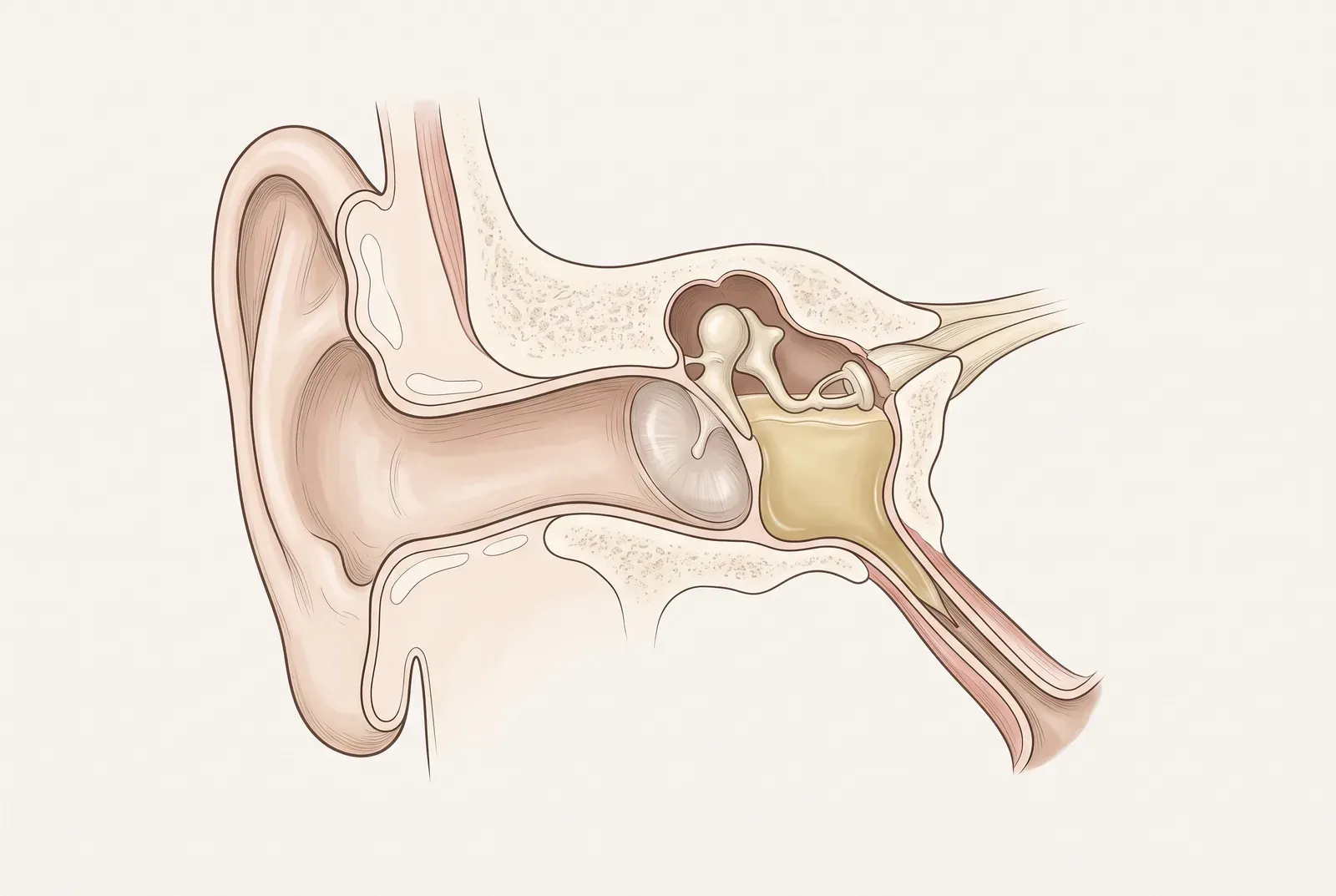
What is glue ear?
The middle ear is a small space behind the eardrum that should be filled with air. It is ventilated by the eustachian tube, which connects the middle ear to the back of the nose. When that tube does not work properly the pressure in the middle ear falls, fluid is drawn from the tissues and the space fills with fluid. When this happens without the signs of an acute infection (fever, severe earache, discharge), the condition is called otitis media with effusion, widely known in English as glue ear.
It is not the same as acute otitis media, in which pain, fever and inflammatory changes of the eardrum predominate. Fluid may remain for weeks after an acute ear infection, or it may develop without any obvious infection; upper respiratory infections, allergic rhinitis and enlarged adenoids are common factors that affect eustachian tube function.
While fluid remains in the middle ear the eardrum and the ossicles cannot vibrate freely, which produces a conductive, usually mild and fluctuating reduction in hearing. When the fluid clears, hearing generally returns to its previous level.
What parents usually notice
Because the condition is often silent, the signs frequently look behavioural rather than ear-related:
- Turning the television up, or sitting closer to it
- Responding late when called, or often asking for things to be repeated
- Difficulty following speech in noisy places
- Slowing of speech development, or unclear pronunciation of some sounds
- A feeling of fullness in the ear, occasional mild earache, brief clumsiness of balance
- Reduced attention and participation at school
These signs are not specific to middle-ear fluid; other causes of reduced hearing can present in the same way. The purpose of assessment is therefore to establish whether hearing is genuinely affected and what is causing it.
What is done at examination and hearing assessment?
The assessment begins with a detailed history: how long the complaint has lasted, previous ear infections, how often upper respiratory infections occur, difficulty breathing through the nose, snoring and mouth breathing, allergic complaints, speech development and progress at school.
During the examination the eardrum is inspected with an otoscope; guidelines emphasise pneumatic otoscopy, which assesses the mobility of the eardrum, as the primary diagnostic method. Tympanometry measures middle-ear pressure and eardrum movement and supports the diagnosis; it is painless and takes only a short time.
A hearing test is the key investigation guiding management, carried out with a method appropriate to the child’s age and development. Guidelines recommend recording at each assessment whether the fluid is on one or both sides, how long it has been present and how much it affects hearing; in children with bilateral fluid and hearing loss, reassessing hearing after three months is the standard approach.
Assessment of the nasopharynx completes the picture, particularly in children with difficulty breathing through the nose, snoring and repeated ear problems, because enlarged adenoids can affect the function of the eustachian tube.
Observation and treatment principles
The natural course of middle-ear fluid is favourable in most children: the fluid may clear on its own within a defined period. The shared approach of the guidelines is therefore a three-month period of observation in children who are not in an at-risk group. Observation is not the same as doing nothing: during this period hearing, speech development and the effects on communication and school are monitored, and families are shown practical ways of making listening easier at home and in the classroom.
Children whose hearing is not affected do not need treatment, and this should be explained clearly to the family. Where hearing is affected and the fluid persists, the options are weighed together according to the child’s age, how long the picture has lasted and its effect on daily life. The current NICE guideline (NG233) recommends discussing the benefits, risks and practical aspects of each option with the family; monitoring and support, auto-inflation, hearing aids and grommets (ventilation tubes) are considered in that framework. Grommets are one of the options that may be considered for hearing loss caused by the fluid; they are not needed by every child.
Guidelines do not recommend the routine use of antibiotics, oral or intranasal corticosteroids, antihistamines or decongestants to clear middle-ear fluid; their benefit in this condition has not been shown. Where allergic rhinitis or enlarged adenoids accompany the picture, those are addressed under their own headings.
In children at risk for speech and language development, for example those with a developmental diagnosis or another hearing problem, assessment and decision-making are brought forward. This page deliberately contains no drug names, doses or treatment durations.
How does it differ from sudden hearing loss?
The two are not alike and should not be confused. Glue ear is common in children, begins insidiously, is painless, fluctuates and produces a conductive reduction in hearing; observation is often part of the approach.
Sudden hearing loss develops within hours or over up to three days, usually affects one ear and may arise in the inner ear; guidelines treat it as a condition requiring assessment without delay. If hearing in a child or an adult falls markedly over a short period, it should not be attributed to fluid and left to time; the distinction is made by examination and a hearing test.
When should assessment be brought forward?
In the following situations it is appropriate to be assessed without waiting for the three-month observation period:
- A marked reduction in hearing over a short period
- A pause or a step backwards in speech and language development
- Discharge from the ear, severe pain or high fever
- Swelling, redness or tenderness behind the ear
- Accompanying symptoms such as facial weakness or dizziness
- Fluid that persists on one side only, or unusual examination findings
None of these findings on its own indicates a particular diagnosis, but each is a reason not to postpone assessment.
Frequently asked questions
Does glue ear clear up on its own?
In most children the fluid clears within a defined period, which is why the guideline approach for children who are not in an at-risk group is a three-month period of observation. During that time hearing and speech development are monitored; if the fluid persists and affects hearing, the options are reviewed again.
Does every child need grommets?
No. Grommets are one of the options that may be considered when fluid persists and affects hearing; monitoring, hearing aids and supportive strategies are also options. The decision is made with the family according to how long the picture has lasted, how much hearing is affected, the child’s age and the effect on daily life.
Will antibiotics or allergy medicines clear the fluid?
Guidelines do not recommend the routine use of antibiotics, corticosteroids, antihistamines or decongestants to clear middle-ear fluid, because their benefit in this condition has not been shown. Accompanying conditions such as allergic rhinitis are treated separately under their own headings.
What is the connection with enlarged adenoids?
Enlarged adenoids sit next to the opening of the eustachian tube and can make ventilation of the middle ear more difficult, contributing to fluid persisting. The nasopharynx is therefore also assessed, particularly in children with difficulty breathing through the nose, snoring and repeated ear problems.